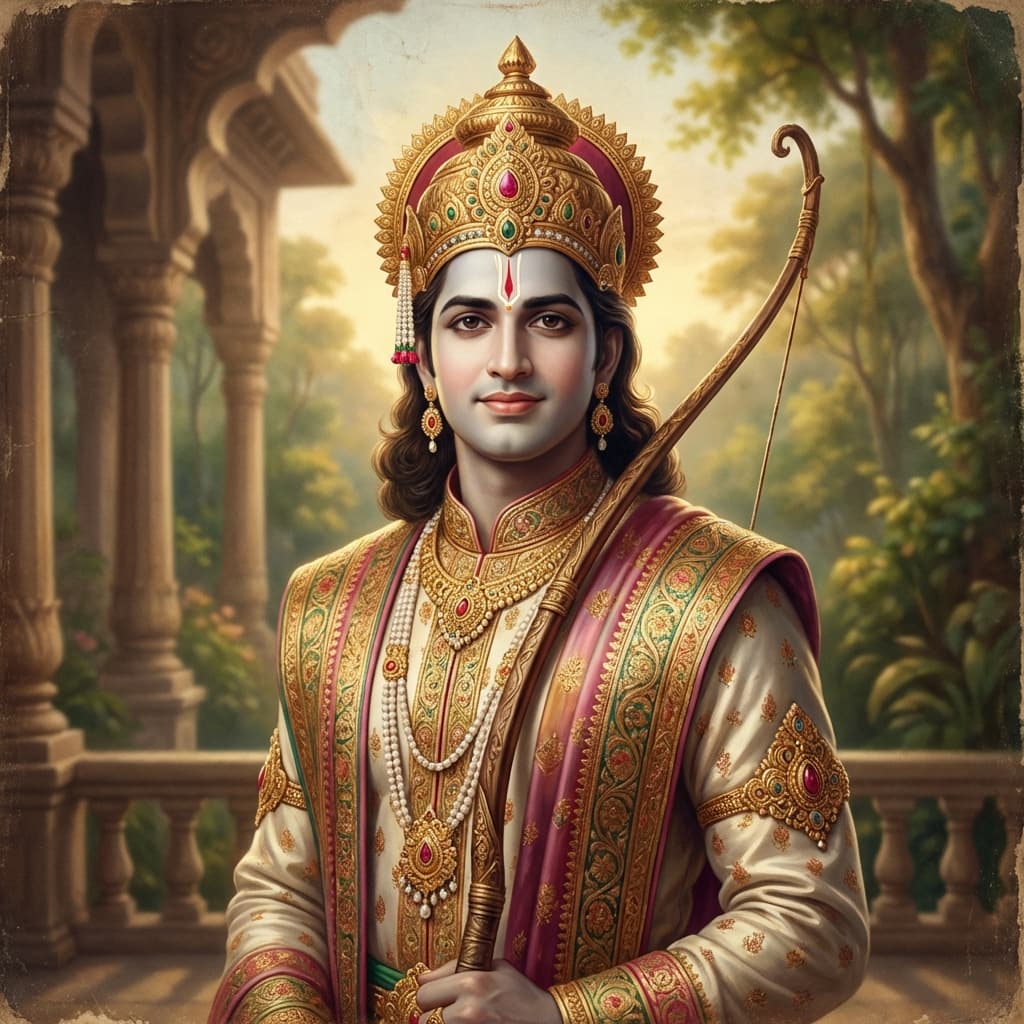
Lord Rama, called Maryada Purushottam, is considered the ideal man of Hinduism and the seventh avatar of Vishnu. His life is an unparalleled example of truth, dharma, duty, and ideals. Rama, son of King Dasharatha of Ayodhya and Mother Kaushalya, was born in Treta Yuga. The description of his life is found in Valmiki Ramayana, Tulsidas's Ramcharitmanas, and many other texts.
Rama ji's life is full of struggles and ideals. He stayed in forests with his wife Sita and brother Lakshmana during exile. After Sita's abduction by Ravana, he attacked Lanka with the help of the vanar army and Hanuman ji, and killed Ravana while protecting dharma. This event is considered an eternal symbol of the victory of good over evil.
Rama is not only worshipped as a great warrior but also as an ideal son, ideal husband, and ideal king. Returning to Ayodhya, he established Ramrajya, which was full of justice, compassion, and prosperity. He did not retreat from facing any difficulty for the observance of truth and dharma, therefore he is called Maryada Purushottam.
Ram Navami is his main festival, celebrated on Shukla Navami of Chaitra month. Diwali is also associated with Shri Rama, celebrated in memory of his return to Ayodhya after completing 14 years of exile. Not only in India, but in countries like Nepal, Thailand, Cambodia, and Indonesia, Ram katha and his ideals are widely worshipped.
Rama's character is an ideal of devotion and dharma. Devotees adopt the path of courage, compassion, and dharma by remembering his name. His life and leelas are still a source of inspiration for society and culture.
Consort
Sita
Parents
Father: Dasharatha, Mother: Kaushalya
Abode
Ayodhya • Saket Lok
Major Festivals (Detailed)
Ram Navami
Chaitra • Shukla • Navami
Mar/Apr • India
WorshipFastingBirth Festival
Diwali
Kartik • Amavasya •
Oct/Nov • India and World
Festival of LightsRama's Arrival
Dussehra
Ashwin • Shukla • Dashami
Sep/Oct • India
FestivalVictory of Good over Evil
Iconography & Attributes
Bow-ArrowRoyal CrownLotusMaryada PurushottamDharma ProtectorTruth-lovingIdeal King
When is Ram Navami celebrated and how is it celebrated?
Ram Navami is celebrated on Chaitra Shukla Navami (Mar/Apr) and is celebrated with devotion as the birth festival of Lord Rama. Special worship, havan, bhajan-kirtan, and recitation are organized in temples and homes. In many places, recitation of Ramayana, staging of Ramlila, and public charity works also take place. Devotees keep fasts and remember Rama's name in morning prayers and perform aarti and bhajan in the evening.
What is the difference between Ramcharitmanas and Valmiki Ramayana?
Valmiki Ramayana is an ancient Sanskrit epic considered composed by Valmiki Muni and contains a detailed, chronological description of Rama's biography. Ramcharitmanas composed by Tulsidas is in Awadhi language and is a devotion-oriented and folk-entertainment transformation of Valmiki's story—which emphasizes devotion and morality. Both texts are important—one classical (Valmiki) and the other devotion-oriented, folk-famous (Tulsidas).
What is the meaning of Ramrajya and why is it relevant for today's society?
The general meaning of Ramrajya is an ideal state where governance is based on dharma, justice, compassion, and prosperity. It is not just a political concept but a symbol of moral and social ideal—governance of justice, protection of the poor, loyalty, and administrative transparency. In modern context, Ramrajya is seen as an inspiring ideal of how leadership can be connected with responsibility, ethics, and public welfare.
What are the learnable aspects of ideal marital relationship between Ram-Sita?
Ram-Sita's relationship demonstrates the ideal of dignity, surrender, and mutual respect. Sita's loyalty and firmness and Rama's dharma-devotion and ability to protect—both give the message of honesty, responsibility, and respect in married life. It also teaches how to maintain restraint and observance of ideals in difficulties.
How was Rama a war hero—what were the main elements of his strategy and policy?
Rama's strategy had dharma-based decisions, coordination with friends and army, and steadfastness towards goals. He effectively led the vanar army, gave importance to dialogue and consultation, and followed the rules of war. Rama's ideal was that war should only be for the protection of dharma—therefore his policy required ethics and clear goals.
What guidance does Rama's ideal leadership give to today's leaders?
Rama's leadership included ethics, self-sacrifice, public welfare, and justice. For modern leaders, this indicates that use of power should be in public benefit, transparency, and sensitivity. Rama's example shows that making decisions in the interest of society, not personal gain, makes leadership great.
What is the importance of Ramlala's idol and Ram Janmabhoomi?
Ramlala idol and Janmabhoomi are religious-cultural symbols—they are centers of devotion, faith, and cultural identity. The history and controversy of Ram Janmabhoomi in Ayodhya have both existed; but from a modern perspective, this place has become an important center of global religious tourism, cultural remembrance, and community events.
What is the cultural importance of Ramlila and how is it presented?
Ramlila is a dramatic presentation of Ramayana's stories which demonstrates community participation, music, dance, and life values. Often staged on open stages during festivals, it becomes a medium of social education, tradition, and collective emotional unity.
What is the relationship between Diwali and Rama—why is Diwali connected to Rama?
One major meaning of Diwali is—the festival of Rama's return to Ayodhya when he returned after 14 years of exile. People welcomed him by lighting lamps—this event connected the festival of lamps, and it became a symbol of victory of light over darkness. Therefore, Diwali is considered a festival of Rama's arrival and light, joy, and fraternity in society.
How can Rama's exemplary aspects help in personal morality?
The values of Rama's life—truth-loving, duty-devotion, compassion, and self-control—give moral guidance in personal life during difficult decisions. When a person is in religious/moral dilemma in any field, Rama's ideals teach that renouncing immediate benefit for long-term moral benefit is appropriate.
Which parts of Ramayana are suitable for teaching to children simply?
For children, straightforward simple moral narratives—such as the message of Sita-protection, Hanuman's loyalty, Lakshmana's surrender, and Ayodhya's ideal royal behavior—these stories can be taught in an interesting way through pictures, songs, and drama. Add moral education (truth, courage, compassion) with each story so children learn values from them.